
Discover the remarkable story of how God's Word was preserved and triumphantly delivered to the world through the King James Bible.
A forged document that claimed the Roman Emperor Constantine gave the Pope authority over the Western Roman Empire. This was debunked as a forgery in the 15th century.
Questions surrounding the authenticity of this ancient manuscript, with allegations that it was altered by the Roman Catholic Church.
Doubts about the reliability of the Vaticanus manuscript, another ancient text favored by modern textual critics.
William Tyndale's tireless efforts to translate the Bible into English have left an indelible mark on the Christian faith. His unwavering belief in the ultimate authority of Scripture fueled his mission to make God's Word accessible to the common people.
These verses clearly state that God has spoken His pure words, which we can know with certainty. This is a powerful promise that the King James Bible faithfully preserves God's inspired and inerrant word.


How did the Waldensian Bible influence other translations of the Bible?
Vigilantius was a 4th-century Christian who lived in the European Alps, and some historians believe that he may have been a proto-Waldensian.
The Waldensians were known for their emphasis on the authority of scripture, their rejection of the wealth and power of the Catholic Church, and their commitment to living a simple, apostolic life. They were also known for their itinerant preaching and their use of vernacular languages in their worship services.
The Waldensians faced persecution by the Catholic Church, which viewed them as heretics and a threat to its authority. Many Waldensians were tortured, exiled, and martyred, but the movement continued to survive and thrive.
In the 12th century, the Waldensian movement gained more prominence and spread across Europe. The Waldensians continued to face persecution and were declared heretics by the Catholic Church.
In the 16th century during the Protestant Reformation, the Waldensians aligned themselves with the Protestant movement and sought religious freedom. They faced intense persecution from the Roman Catholic Church during this time, but their commitment to their beliefs and their determination to preserve God's Word sustained them.
In 484 AD, 460 orthodox bishops risked everything. Summoned by Arian king Huneric, they faced a deadly trap disguised as religious debate.
Huneric, the Vandal king, convened the council to undermine Trinitarian doctrine and promote Arianism.
The bishops collectively affirmed 1 John 5:7 in their confession: "There are three that bear record in heaven..."
For defending this verse, bishops were exiled, tortured, and martyred by Arian authorities.
This proves 1 John 5:7 existed centuries before critics claim it was "added" to manuscripts.
Their blood-sealed testimony refutes modern textual critics. These weren't marginal scribes but hundreds of church leaders defending Trinitarian truth at the cost of their lives.

Gamma embed
The Council of Carthage & the 460 Bishops
In 484 AD, hundreds of bishops stood firm against an Arian king, creating one of history's most dramatic showdowns between competing Christian theologies. Their story connects directly to controversial biblical passages we still debate today. Learn About the Trinitarian Controversy

02:51:31
YouTube
Was 1 John 5:7 "Added" to the Bible? (Ft Mike Ferrando, Nick Sayers...) | Truth is Christ Podcast #4
Ft. Mike Ferrando, Nick Sayers, Mike Hollner, Joey Faust, and Ante Pavkovic. Did Erasmus add 1 John 5:7 to the Bible as scholars claim? Why is this verse lacking in Greek manuscript evidence? And are there any witnesses to this verse in the early church? Can we prove this verse is inspired? The 1 John 5:7 discussion begins at timestamp 28:04 - 1 John 5:7-8 KJV: For there are three that bear record in heaven, the Father, the Word, and the Holy Ghost: and these three are one. And there are thr
Scripture integrity is essential for Christian testimony. Altered Bible verses undermine our witness to the world.
How can we expect non-believers to trust Christianity when we're uncertain about God's words?
The King James Bible preserves authentic Scripture, giving believers confidence in sharing God's truth.

20:56
Bible Version Corruption Explained - King James VS Modern Fake Versions - Majority VS Minoirty Text
The "thee's" and "ye's" of the KJV are not a barrier to understanding, but rather add richness and beauty to the language. The KJV remains highly readable and accessible for modern audiences.
Claims that King James was gay are unfounded. The KJV translation was the work of 47 highly qualified scholars, not influenced by the king's personal life.
The KJV was not altered to suit the king's personal preferences. The translators faithfully preserved the inspired text, without making changes for political or personal reasons.
The influential textual critics Westcott and Hort were influenced by the occult and harbored a deep hatred for the Textus Receptus, the basis of the King James Bible.
Erasmus, a brilliant scholar, compiled the Textus Receptus, the Greek text that underpins the KJV. His life's work laid the foundation for this timeless translation.
William Tyndale, the father of the English Bible, was martyred for his devotion to bringing God's word to the common people. His legacy lives on in the KJV.
The vast majority of ancient manuscripts come from the Byzantine and Antiochian regions, forming a unified textual stream that supports the KJV. Modern critics often ignore this overwhelming manuscript evidence.
Claims that Jesus and the Apostles used the Septuagint are questionable, as the existence of this ancient Greek translation prior to the 1st century AD is difficult to prove.
The influential scholar Origen was not faithful in his handling of the Greek text, as attested by Jerome, the translator of the Latin Vulgate.
NASB Bible Co-Founder "I made a Terrible Mistake" - Frank Logsdon Recants
Authoritative works like "Which Bible?" provide in-depth analyses and defenses of the King James Bible.

David Daniels shows the evidences of white pages and broken up wormholes that make the undeniable proof, Codex Sinaticus is a work from Constitine Simodities in the 19 century

Septuagint is not used by early church, don't fall for the myth.
Nick Margus
Channels such as "Truth in Christ" and speakers like Sam Gipp offer compelling insights and debates on the KJV debate.
Channels like Tiny Life Big Mission -
Check out Videos like Scroll Publications
Latest By David Daniels
What about missing verses?

Engaging debates between KJV advocates and modern textual critics, like those involving Dr. James White, Dan Wallace, Bart Uhrman and Mark Ward, shed light on the ongoing scholarship.
Check out Videos like THIS
Is the Modern Bibles just good enough?
Rooted in the work of the early Church Fathers, the KJV stands as the culmination of centuries of faithful preservation and transmission of God's Word.
The KJV is based on the Textus Receptus, which is supported by the overwhelming majority of ancient manuscripts, ensuring the fidelity of its text.
The King James Bible has shaped Western civilization, influenced literature, and continues to be the most widely used and trusted translation of the Scriptures.
Unlike a fast food chain where you can customize your order, the King James Bible is not something you can change to fit your own preferences. Just like the classic Whopper burger, if it's not broken, there's no need to fix it! As it says in Proverbs 22:28, "Remove not the ancient landmark, which thy fathers have set."
It's important to remember that the Bible is not a buffet where you can pick and choose which verses you like or agree with, and then try to interpret them in a way that aligns with your own beliefs. Instead, we should approach the Bible with reverence and humility, seeking to understand and apply its teachings as they were originally intended.

When it comes to modern Bible translations, not all are created equal. Some shine with accuracy and reverence, while others fall short, undermining core Christian doctrines.
Hey but isn't the new king James just good enough?

27:47
KJV vs NKJV - Are They Really THAT Different??? | COMPARING the NKJV and KJV

In his teachings, James White promotes unbiblical views that challenge the authority of the King James Bible. Despite his claims of being a "Christian apologist," White's theological positions and affiliations often contradict the fundamentals of the Christian faith.
White denies the essential doctrines of the Christian faith, including the inerrancy of Scripture, the deity of Christ, and the penal substitutionary atonement of Christ. He also promotes ecumenicalism and interfaith dialogue, which are contrary to the clear teachings of Scripture.
PO- Only the AUTOGRAPHS are Inspired
PO-modern myth (GOD can preserve HIS Word Perfectly)
KJVO- modern myth(Only the AUTOGRAPHS are Inspired)
KJVO- GOD can preserve HIS Word Perfectly
Second Timothy 3:15–3:16
The inspiration of the King James Version (KJV) can be seen through its enduring impact and faithful transmission of God's Word. 2 Tim 3:15 reminds us that "the holy Scriptures...are able to make you wise for salvation through faith in Christ Jesus." This verse emphasizes the power and authority of Scripture, regardless of whether it is the original autograph or a faithful translation like the KJV.
'The authenticity and authority of God-inspired Bible is a very foundation of Christianity. Even if we should be admitted that Christ is deity, we have no certain way of knowing the truth about Christ, about the way of salvation, no assurance of heaven and eternity, no sweet promises, no way to know Christian duty, to grow Christian character, or preach the Christian gospel, without an inspired Bible. We had as well settle it to start with that it is the Bible in Christ or no Bible, no Christ, no salvation, no Christianity.' John R. Rice
Those who believe only in the modern "perversion" translations of the Bible, rejecting the superiority and authority of the King James Version (KJV). They claim the KJV is outdated and inaccurate, promoting a skewed, watered-down version of Scripture.
Defenders of the KJV who believe it is the sole, divinely-preserved Word of God. They reject all other modern translations as flawed, compromised, and dangerous deviations from the true, inspired text.
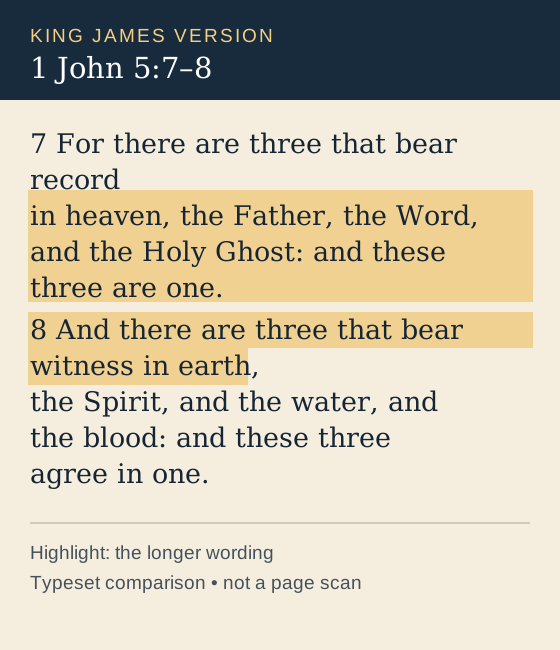
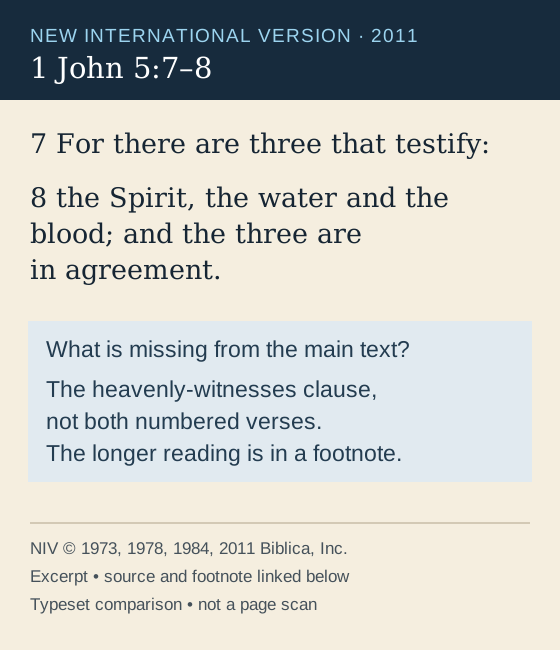
The Comma Johanneum, or Comma Johannine, is the text in 1 John 5:7-8 that every trinitarian loves and defends. This passage refers to the "three that bear witness in heaven: the Father, the Word, and the Holy Spirit; and these three are one." It is considered a key proof-text for the doctrine of the Trinity, as it explicitly names the three persons of the Godhead.
The exclusion of this text has been the subject of intense scholarly debate for centuries. The Comma Johanneum remains a touchstone for Christians because of the clear scriptural affirmation of the triune nature of God. Here are some clear early examples of this passage being used earlier than the modern textual scholars want you to see or understand.
Understanding Criticisms of the King James Bible
Translation Accuracy: Critics argue that the KJV translation process relied on fewer and later manuscripts, raising concerns about its accuracy compared to translations based on more ancient and diverse textual sources. Supernatural Preservation Claims: Some critics dismiss claims of the KJV being supernaturally preserved as lacking scholarly support and consider them unfounded. Archaic Language Barrier: The archaic language used in the KJV poses a significant hurdle for modern readers, impacting their comprehension and the Bible's relevance. Inclusion of Apocryphal Books: The inclusion of the Apocrypha in older versions of the KJV remains a subject of controversy among Christian denominations. Male-Centric Language: Critics highlight the KJV's use of male-centric language, which can alienate contemporary readers seeking a more inclusive and gender-neutral translation. Historical Context Concerns: The political and religious motivations behind the commissioning of the KJV raise questions about potential biases in the translation and interpretation of biblical texts. Literal vs. Dynamic Equivalence: Some critics argue that the KJV's commitment to a more literal translation approach might result in a less nuanced representation of the original texts. Misinterpretations and Ambiguities: The complex language of the KJV has led to potential misinterpretations and ambiguities in certain passages. Cultural and Anachronistic References: The KJV's references to outdated customs and cultural practices can hinder the application of biblical teachings in a contemporary context. Lack of Accessibility: Critics contend that the KJV's lack of accessibility limits its effectiveness in conveying the message and moral teachings of the Bible to a diverse and modern audience. The Most Powerful Book in the World Archaic Words in the KJV Why the NWO Hates the KJV The King James Bible vs. Modern Bible Versions The Preserved Bible: Full Documentary On The King James Bible The King James Code Part 1 - Bible Numerics