Their published study appeals to scholarly acceptance and comparison of manuscripts, including early witnesses. That is their stated reason for the choice; each reading still needs examination.
Hort’s hostility toward the received text is plain in his own words. In the same letter, he welcomes changes supported by manuscripts and the availability of early witnesses.
Did that hostility affect his decisions?
Read the context
That question needs evidence from individual readings. His language shows his attitude; it cannot, by itself, prove that a particular Greek reading is wrong.
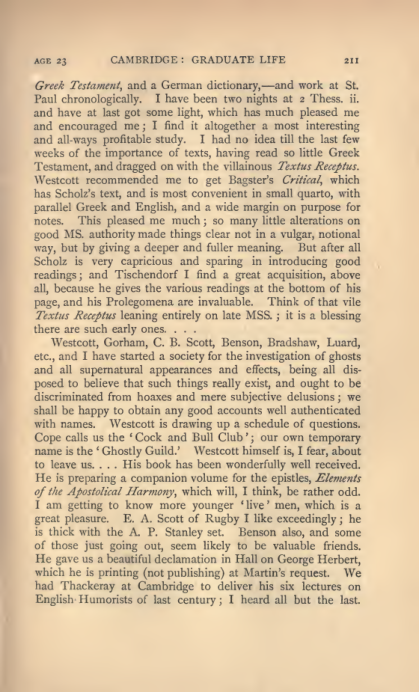
Hort naming Westcott and fellow members · volume 1, page 211
Hort says the group was disposed to believe such phenomena existed. He reports that Westcott was preparing questions, and gives its temporary name: the “Ghostly Guild.”
Is this an interest you would expect of Bible editors?
Read the context
The letter describes investigating reports and separating them from hoaxes and subjective delusions. It documents that interest and the named participants; it does not establish spirit worship or every later allegation about them.
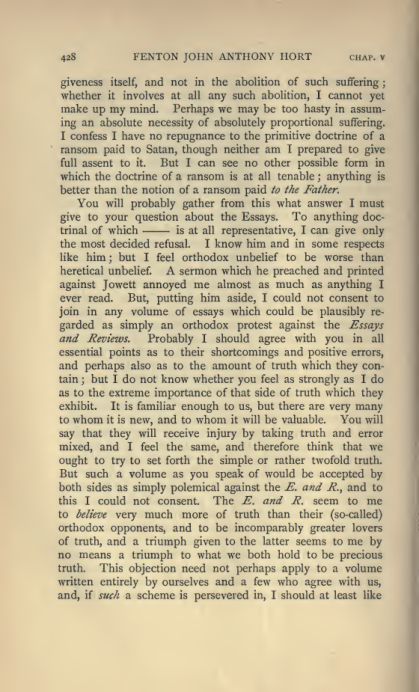
“anything is better than the notion of a ransom paid to the Father.”
Hort · volume 1, pages 427–428
Hort rejects this explanation of the ransom. He considers a ransom paid to Satan, while explicitly withholding full assent to that view.
How does that fit your understanding of Christ’s death?
Read the context
The preceding page affirms that we are saved by the Lord’s death. His disagreement over its explanation should not be turned into a claim that he denied Christ’s saving death altogether.
No. A Greek edition concerns which Greek words are printed. Translation concerns how they are rendered. The ESV’s preface also identifies UBS and Nestle–Aland editions as its New Testament base, with departures at some readings. This does not mean it was translated from the NWT, or that all modern versions have an identical text or doctrine.
 Enlarge original page ↗