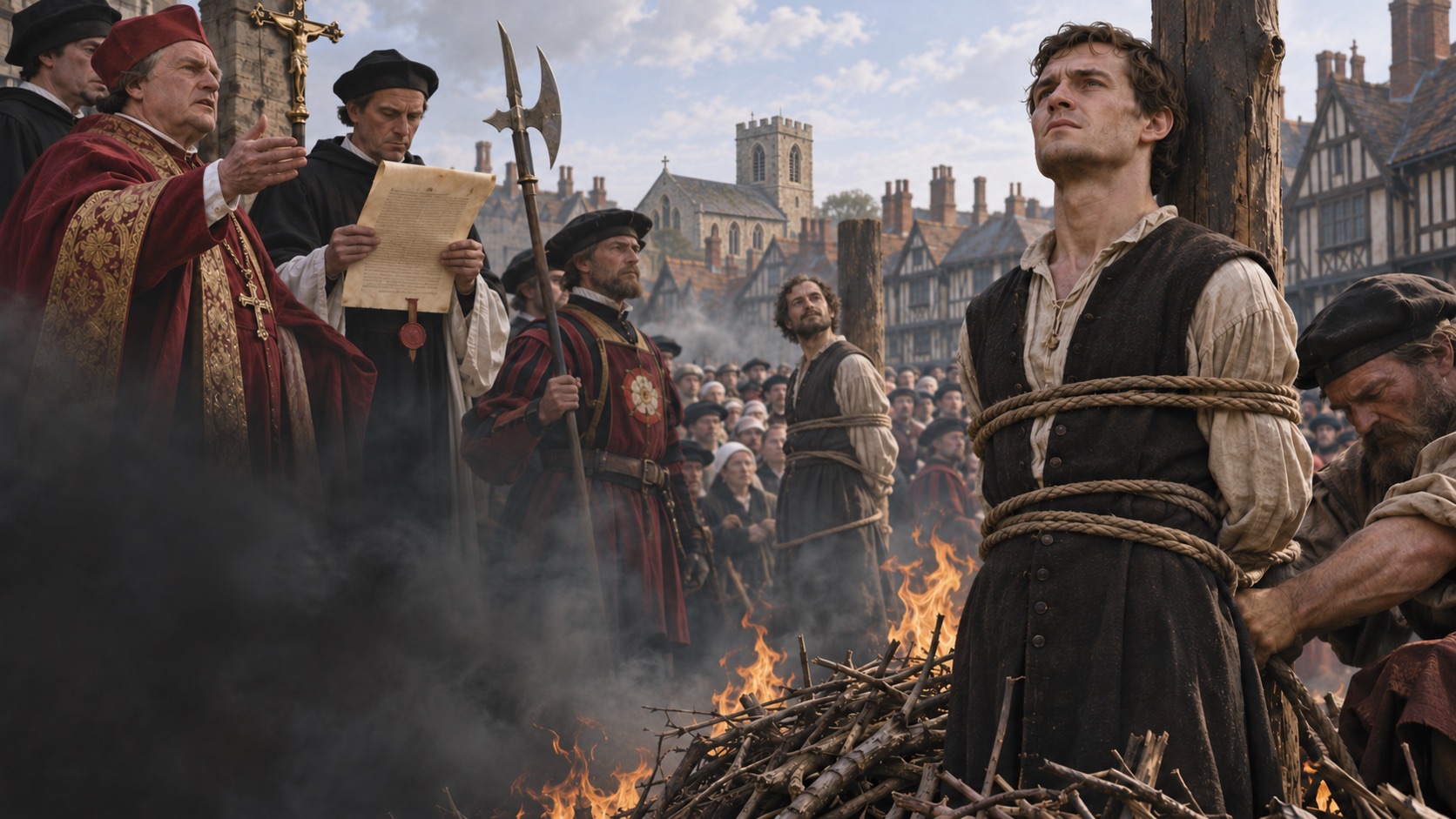
Smithfield, London · 4 July 1533
John Frith
Tyndale’s fellow worker defended his beliefs with Scripture. Bishop John Stokesley condemned him over Catholic doctrines he rejected. Frith was burned with Andrew Hewet.
- His work
- Reformation writer and Tyndale’s colleague
- Place of execution
- Smithfield, London
- Year
- 1533
A scholar who wrote for readers
He argued from Scripture.
Frith studied at Cambridge and Oxford, joined the reforming movement and worked with William Tyndale abroad. He translated and wrote religious works in English.
His writings challenged purgatory and explained his understanding of the Lord’s Supper. He believed disputed teaching about the sacrament should not be made a condition of salvation. He continued writing while imprisoned.
Dictionary of National Biography: John Frith ↗ · Schaff–Herzog Encyclopedia: John Frith ↗
The charge · Doctrine
His beliefs were put on trial.
Frith rejected transubstantiation—the Catholic teaching that the bread and wine become Christ’s body and blood while their outward appearances remain. He also denied purgatory.
Bishops John Stokesley and Stephen Gardiner were involved in his examination. Henry VIII ordered proceedings, and Archbishop Thomas Cranmer also questioned him. This happened during Henry’s break with Rome; the English authorities continued to punish rejection of these Catholic teachings.
Dictionary of National Biography: John Frith ↗ · Schaff–Herzog Encyclopedia: John Frith ↗
A church verdict, followed by civil execution
Stokesley condemned him to the stake.
After Frith refused to recant, John Stokesley, bishop of London, condemned him. He was handed to the civil authorities and held in Newgate.
On 4 July 1533, Frith and Andrew Hewet, a young tailor’s apprentice, were burned at Smithfield. The officials who condemned them and those who enforced the sentence share responsibility for what happened.
Dictionary of National Biography: John Frith ↗ · Victoria County History: Frith and Hewet ↗
Conscience under coercion
A doctrinal disagreement became a death sentence.
Frith’s importance reaches beyond a list of Bible translators. He represents the reader and teacher who insists that a doctrine must be tested against Scripture.
His arguments can be examined and challenged. Burning him did neither. From this site’s Christian perspective, it was persecution, not an answer to his teaching.
Read the record
Sources behind the story.
- Dictionary of National Biography: John Frith ↗
- His writings, imprisonment, examination by royal and church authorities, and condemnation.
- Schaff–Herzog Encyclopedia: John Frith ↗
- Summarizes his teaching on the sacrament, published works and Stokesley’s verdict.
- Victoria County History: Frith and Hewet ↗
- Records their execution together at Smithfield on 4 July 1533.
The illustration is a historical composite. It does not establish a particular official’s presence or physical actions. Historical claims are linked above; moral and theological judgments are this site’s Protestant commentary.