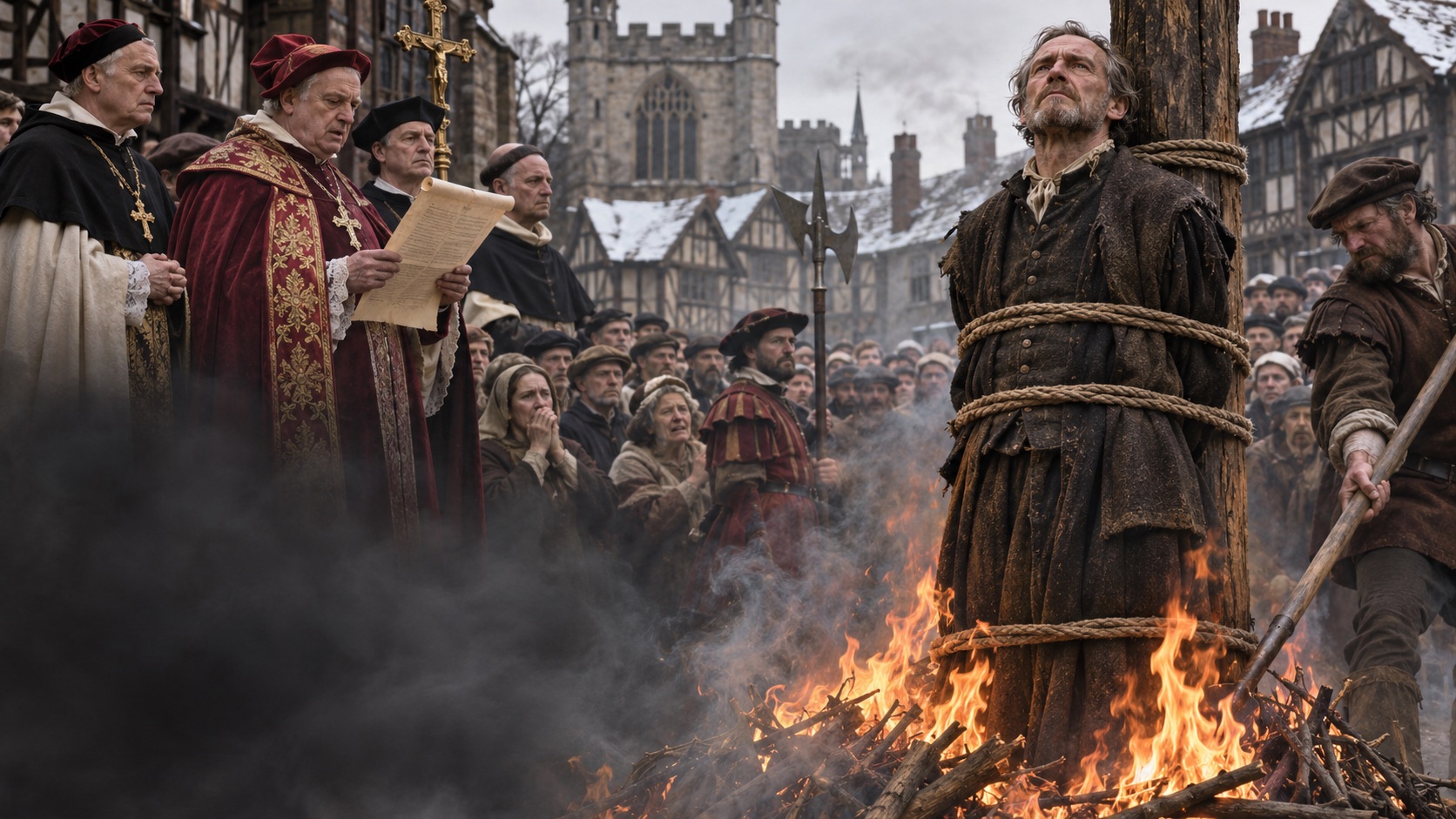
Smithfield, London · 4 February 1555
John Rogers
He helped carry Tyndale’s work into the Matthew Bible. Catholic Bishop Stephen Gardiner condemned him for heresy. Under Mary I, he was burned alive.
- His work
- Bible editor and preacher
- Place of execution
- Smithfield, London
- Year
- 1555
The Matthew Bible · 1537
He helped the English Bible reach another generation.
Rogers assembled the Matthew Bible from Tyndale’s translations and the work of Miles Coverdale. It appeared in 1537 under the name Thomas Matthew, with royal permission to be sold in England.
Tyndale’s New Testament and much of his Old Testament work lived on in its pages. Coverdale’s translation supplied the remaining books. Rogers also provided notes and material to help readers study.
The Matthew Bible then became a foundation for the Great Bible. Rogers belongs in the story of how the English Scriptures reached the generations before the King James Bible.
Gruber Rare Books Collection: Matthew’s Bible ↗ · Folger Shakespeare Library: the 1537 Bible ↗
The charge · Heresy
A Bible editor became a prisoner.
After Mary I came to the throne, Rogers continued preaching Protestant beliefs. He was confined and then imprisoned at Newgate.
In January 1555, Stephen Gardiner, the Roman Catholic bishop of Winchester and lord chancellor, examined him. Rogers would not accept the religious settlement being enforced under Mary. His trial concerned his beliefs, including the sacrament and papal authority; it was not simply a prosecution for publishing the Matthew Bible.
Dictionary of National Biography: John Rogers ↗ · John Foxe: Rogers’s condemnation and death ↗
Condemnation and execution
Gardiner condemned him. Civil officers took him to the fire.
Rogers was condemned as a heretic and stripped of his clerical status. On 4 February 1555, civil authorities took him to Smithfield, where he was burned alive.
He became the first Protestant burned in Mary I’s persecution. The Catholic condemnation and the state’s enforcement both belong in the account of his death.
Dictionary of National Biography: John Rogers ↗ · John Foxe: Rogers’s condemnation and death ↗
The work survived
The fire could not recall the printed pages.
A Bible reaches a reader through many hands: translators, editors, printers and distributors. Rogers’s part was to bring earlier work together and help carry it forward.
His execution raises a direct question for any institution claiming Christian authority: what justified killing a man for convictions that should have been answered through Scripture and argument?
Read the record
Sources behind the story.
- Gruber Rare Books Collection: Matthew’s Bible ↗
- Library account of the translation’s contents, royal licence and relationship to the Great Bible.
- Folger Shakespeare Library: the 1537 Bible ↗
- Catalogue record for a surviving copy, identifying Tyndale, Coverdale and Rogers.
- Dictionary of National Biography: John Rogers ↗
- Older scholarly biography covering his editing, imprisonment and examinations.
- John Foxe: Rogers’s condemnation and death ↗
- A Protestant martyrological account. Its religious viewpoint is explicit; individual dramatic details require care.
The illustration is a historical composite. It does not establish a particular official’s presence or physical actions. Historical claims are linked above; moral and theological judgments are this site’s Protestant commentary.