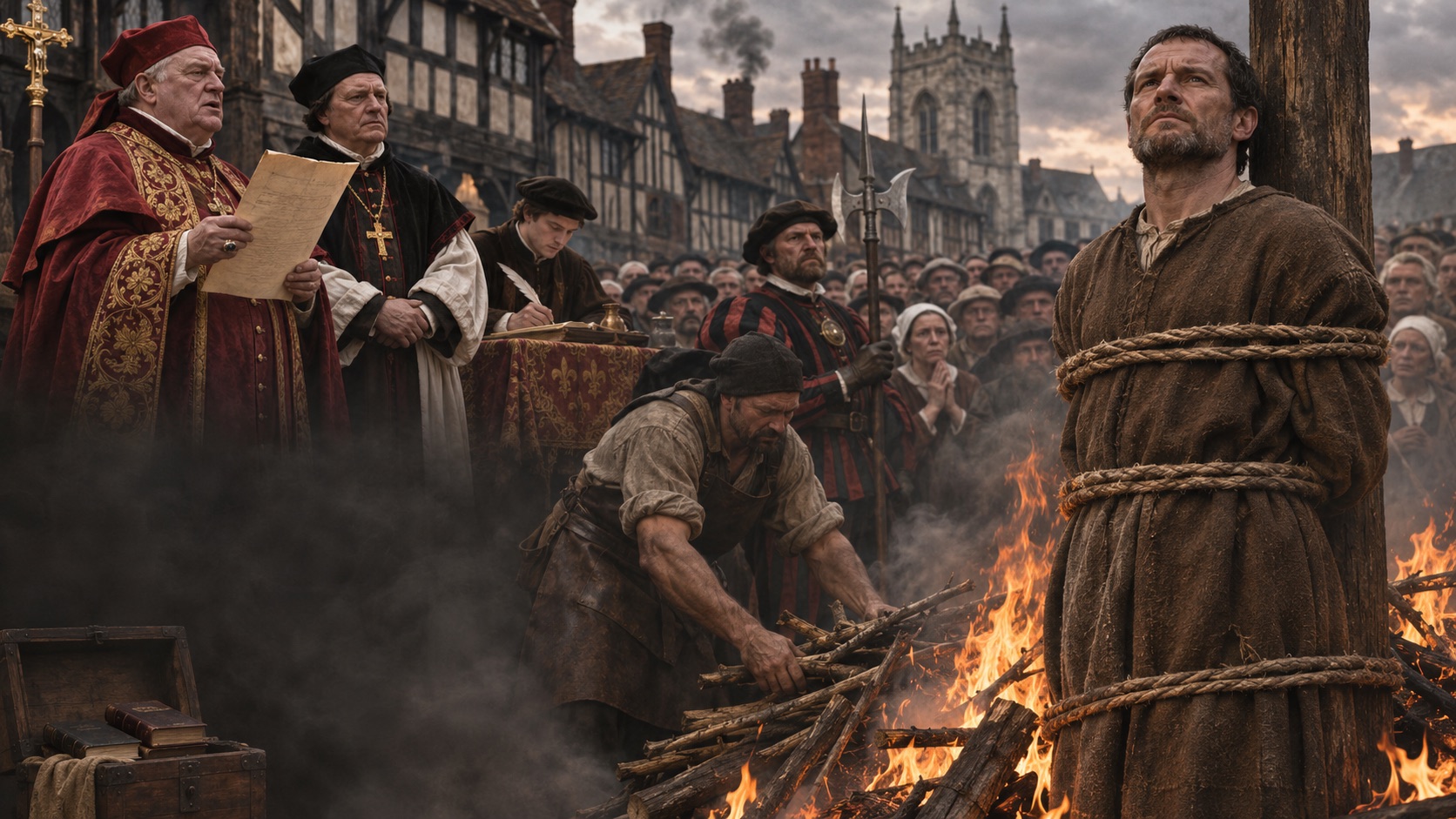
Smithfield, London · 1531
Richard Bayfield
He carried forbidden English Scriptures into England. Catholic bishops prosecuted him for returning to condemned beliefs and importing books. He was burned at Smithfield.
- His work
- Distributor of forbidden books
- Place of execution
- Smithfield, London
- Year
- 1531
The books had to reach readers
He carried what others translated.
Bayfield was a Benedictine monk at Bury St Edmunds. Reading Tyndale’s English New Testament and other reforming works changed his beliefs.
After an earlier prosecution, he went to the Low Countries and helped bring Tyndale’s books into England. His work was distribution: getting printed pages into readers’ hands.
The charge · Relapsed heresy
The authorities made his return to those beliefs a capital matter.
In 1531, Catholic bishops John Stokesley of London and Stephen Gardiner of Winchester examined Bayfield. He had previously renounced condemned opinions. Returning to them made him a “relapsed” heretic in the court’s eyes.
Importing forbidden books was part of the case against him. The prosecution therefore reached both his convictions and his practical work spreading them.
Dictionary of National Biography: Richard Bayfield ↗ · Victoria County History: religious history of London ↗
Smithfield · 1531
He was condemned, degraded and burned.
Bayfield was stripped of his priestly status and burned at Smithfield. Catholic church proceedings supplied the condemnation; civil power carried out the execution.
Sources disagree on the exact day, giving 27 November or 4 December. The year and the execution are clear; the precise day remains disputed.
The courage of a distributor
Translation needs people willing to carry it.
Bayfield’s story puts the distributor beside the translator. A finished book cannot help a reader who never receives it.
His contribution was practical and dangerous. Remembering him means asking why bringing these books to people was treated as a reason to end his life.
Read the record
Sources behind the story.
- Dictionary of National Biography: Richard Bayfield ↗
- Documents his book distribution, examination by Stokesley and Gardiner, sentence and conflicting execution dates.
- Victoria County History: religious history of London ↗
- Places Bayfield’s prosecution within London’s suppression of religious dissent; discusses Stokesley’s responsibility.
The illustration is a historical composite. It does not establish a particular official’s presence or physical actions. Historical claims are linked above; moral and theological judgments are this site’s Protestant commentary.