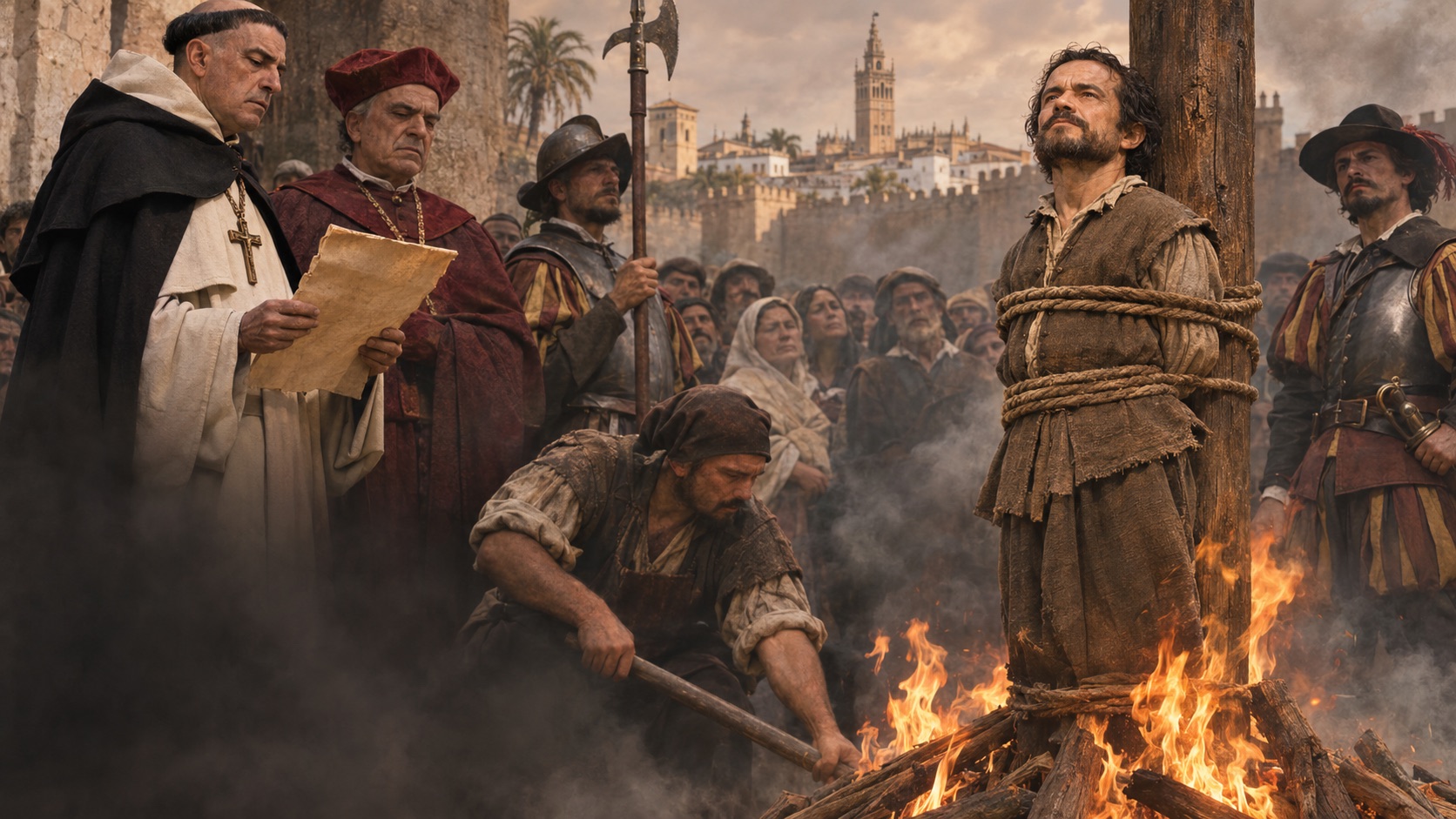
Seville, Spain · 1560
Julián Hernández
He smuggled Spanish New Testaments into Seville. The Spanish Inquisition arrested and tortured him. Its prosecution ended with his death at the stake.
- His work
- Smuggler of Spanish New Testaments
- Place of execution
- Seville, Spain
- Year
- 1560
Scripture in Spanish
Small books crossed a guarded border.
Hernández, often called Julianillo, carried prohibited Protestant books into Spain. Among them were Spanish New Testaments associated with Juan Pérez de Pineda.
Bridwell Library describes copies concealed in wine casks and brought into Seville. The small books could travel where open publication could not.
The surviving 1556 edition was printed in Geneva under a false publisher’s name and a Venice imprint. The disguise illustrates the pressure on those producing and distributing Spanish Scripture.
The Seville tribunal
The Inquisition broke into a network of readers.
Hernández supplied books to reforming circles in Seville, including people connected with the monastery of San Isidoro del Campo. He was discovered in 1557, fled and was captured at Adamuz.
The Roman Catholic tribunal of the Spanish Inquisition prosecuted him. Universidad Pablo de Olavide’s account records torture and says that names were disclosed under that pressure, leading to further arrests.
Condemned in Seville
The tribunal’s case ended at the stake.
After more than three years of proceedings, Hernández was condemned and burned in 1560. The university account dates his death to 22 December.
The Spanish Inquisition’s religious prosecution and the civil execution were connected parts of the persecution. Calling the executioner a civil officer does not remove the Catholic tribunal’s responsibility.
Universidad Pablo de Olavide: Julián Hernández ↗ · Vatican institutional history of the Inquisition ↗
The reader mattered
He helped Spanish readers encounter the New Testament.
Hernández was a distributor, not the translator of the books he carried. His work connected printers abroad with readers inside Spain.
His story makes the cost of censorship concrete. The people carrying a book could be pursued along with the people who wrote, printed or read it.
Read the record
Sources behind the story.
- SMU Bridwell Library: Forbidden New Testament ↗
- A surviving Spanish New Testament, its disguised publication details and Hernández’s smuggling.
- Universidad Pablo de Olavide: Julián Hernández ↗
- Research account of the Seville network, arrest, torture and execution. Some earlier details of his life remain uncertain.
- Vatican institutional history of the Inquisition ↗
- Explains the relationship between inquisitorial judgment and execution by civil authorities; not a case record for Hernández.
The illustration is a historical composite. It does not establish a particular official’s presence or physical actions. Historical claims are linked above; moral and theological judgments are this site’s Protestant commentary.