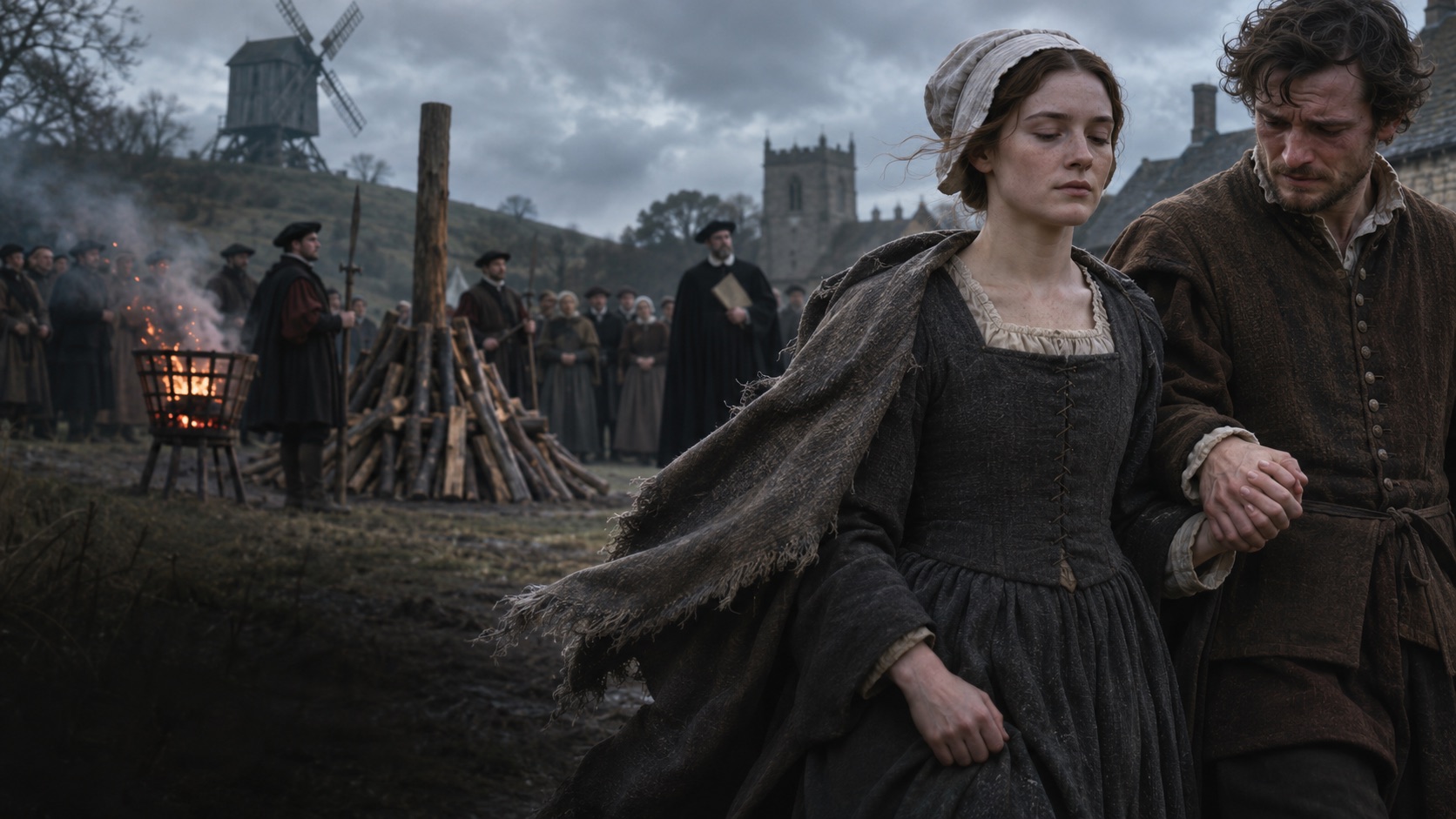
Derby · 1 August 1556
Joan Waste
Blind from birth, she learned Scripture by listening. Catholic church authorities condemned her beliefs about communion. At about twenty-two, she was burned at Derby.
- The work
- Listener and student of the New Testament
- Place of execution
- Derby
- Year
- 1556
Scripture heard and remembered
She saved for a book she could not see.
John Foxe describes Joan Waste as a young woman blind from birth who earned money through knitting and helping with rope-making. She saved enough to buy a New Testament.
John Hurt, an older man imprisoned for debt, read chapters aloud to her. When he could not, she found other readers and sometimes paid them. Foxe says she learned substantial passages by memory.
Her story is about access to Scripture through other people’s voices. These personal details come chiefly from Foxe’s Protestant account.
The charge · The sacrament
Her understanding of communion was put on trial.
Under Mary I, Joan rejected the teaching that consecrated bread and wine became Christ’s actual body and blood. She defended her position by appealing to Scripture and the preaching she had heard.
Ralph Baines, the Catholic bishop of Coventry and Lichfield, and his chancellor Anthony Draycot examined her. They condemned her as a heretic and delivered her to civil officers.
Derby · 1 August 1556
Her brother’s hand was the last familiar guide.
According to the account preserved by Foxe, Draycot preached against her beliefs before the execution. She was then taken to the Windmill Pit, holding her brother Roger’s hand.
Joan was burned on 1 August 1556, at about twenty-two years old. The Catholic condemnation and the civil enforcement of the sentence both belong in her story.
An ordinary believer
She belongs beside the scholars and translators.
The history of the Bible includes the person who listens, remembers and asks what the words mean. Joan’s blindness did not prevent her from taking an active part in that work.
Her story asks Christian readers to consider what authority should do when a believer’s understanding of Scripture conflicts with its ruling.
Read the record
Sources behind the story.
- John Foxe: Joan Waste’s reading of the New Testament ↗
- Excerpt from Foxe’s Protestant martyrology, reproduced in a later selection. Search for Joan Waste; the account describes her work, purchase of the book and readers.
- The Tudor Society: Joan Waste’s trial and execution ↗
- Claire Ridgway recounts Foxe’s account, including the sacramental charge, Draycot’s sermon and the execution. The article’s “Bishop of Derby” label is imprecise; Baines was bishop of Coventry and Lichfield.
The illustration is a historical composite. It does not establish a particular official’s presence or physical actions. Historical claims are linked above; moral and theological judgments are this site’s Protestant commentary.