London · 1401
William Sawtre
He defended his beliefs with Scripture. Archbishop Thomas Arundel’s council condemned him. King Henry IV ordered London’s officers to burn him.
- The work
- Lollard priest and preacher
- Place of execution
- Smithfield, London
- Year
- 1401
Before Jan Hus
A priest answered with Scripture.
William Sawtre, also written Sawtrey, served as a priest in Norfolk and later London. He belonged to the world of Lollard dissent associated with John Wycliffe.
When challenged, he defended his beliefs by appealing to biblical passages and Augustine. He argued that preaching could take priority over reciting the prescribed hours of prayer. His place in this history is as a preacher and interpreter of Scripture.
The charge · Relapsed heresy
The court pressed him about communion.
The central dispute concerned the Eucharist. Sawtre maintained that the bread remained bread after consecration. He also challenged practices involving crosses and pilgrimage.
Catholic Archbishop Thomas Arundel examined him before a church council in 1401. The council treated him as a repeat offender because of an earlier proceeding in Norwich, condemned him and stripped him of his priestly status.
Dictionary of National Biography: William Sawtrey ↗ · The royal writ for Sawtre’s burning · 1401 ↗
The royal writ survives
The council condemned. The king ordered the burning.
Henry IV’s writ of 26 February 1401 names Arundel’s judgment and directs the mayor and sheriffs of London to have Sawtre burned. It presents the punishment as a defence of the Catholic faith.
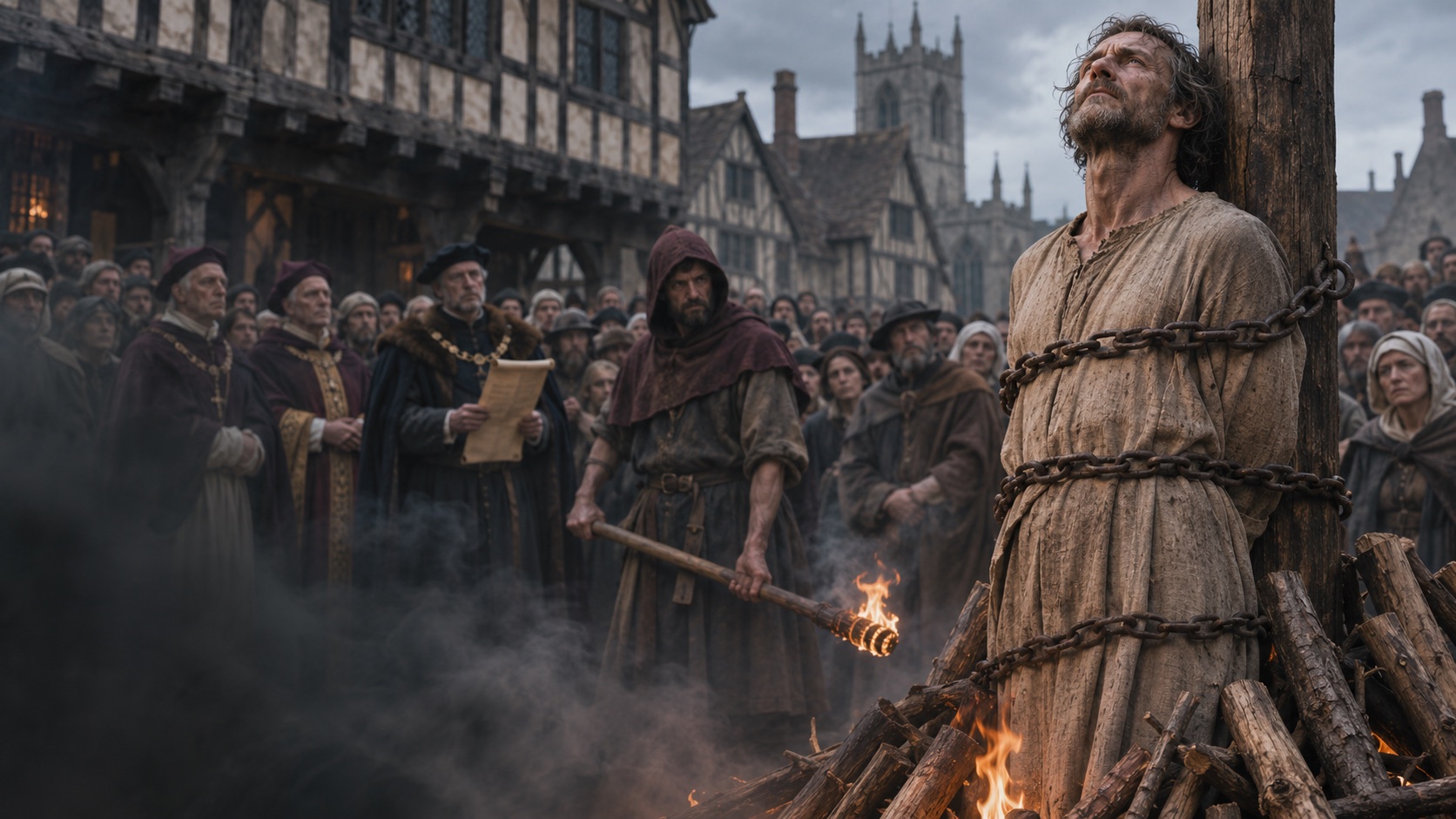
Sawtre was burned at Smithfield in 1401. The surviving order makes the chain of responsibility unusually clear: a Catholic church verdict, a royal command and execution by civic officers.
The royal writ for Sawtre’s burning · 1401 ↗ · Victoria County History: Sawtre’s condemnation and execution ↗
Read the order
An official document takes us behind the fire.
Sawtre’s story belongs before Hus and Tyndale in the timeline. Readers can inspect the order that turned a religious judgment into a public execution.
The question reaches beyond whether a reader agrees with every one of his beliefs. What justified using a fire to settle a dispute about faith?
Read the record
Sources behind the story.
- Dictionary of National Biography: William Sawtrey ↗
- Older scholarly biography describing his arguments and trial. Its claim that the new burning statute already applied is qualified by the chronology in the royal-writ edition below.
- The royal writ for Sawtre’s burning · 1401 ↗
- Primary document in English translation, section XLIII, printed pages 138–139 of Gee and Hardy. The editors distinguish the execution order from the statute then before Parliament.
- Victoria County History: Sawtre’s condemnation and execution ↗
- Historical account of the London proceedings and the burning at Smithfield.
The illustration is a historical composite. It does not establish a particular official’s presence or physical actions. Historical claims are linked above; moral and theological judgments are this site’s Protestant commentary.