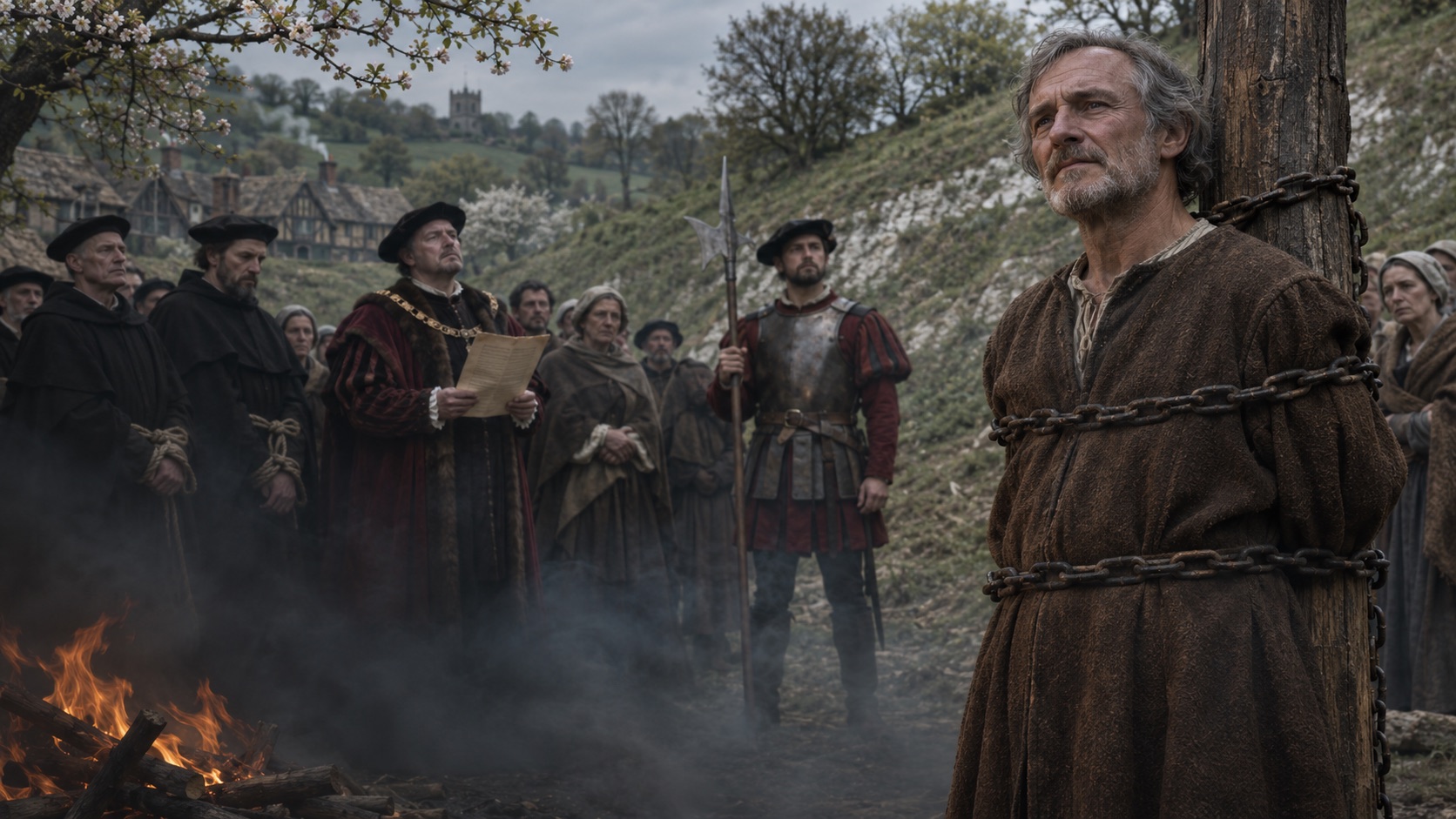
Chesham · 1532
Thomas Harding
Tyndale’s New Testament was found in his home. Bishop John Longland examined him; a Catholic church court sentenced him to burn. He died at the stake in Chesham.
- The work
- Lollard reader of English Scripture
- Place of execution
- Chesham, Buckinghamshire
- Year
- 1532
An English Bible in a home
He belonged to a community of readers.
Thomas Harding and his wife Alice were part of the Lollard community around Amersham and Chesham. They had already faced church proceedings before his final arrest.
In 1532, Harding was discovered reading Tyndale’s The Obedience of a Christian Man. A search of his home found more prohibited books, including Tyndale’s English New Testament.
Amersham Museum: Tyndale’s New Testament and Thomas Harding ↗ · Chesham: the Thomas Harding historical walk ↗
The books and the beliefs
The bishop’s questions led to imprisonment.
John Longland, the Catholic bishop of Lincoln, examined Harding about his reading and beliefs. He was confined in the bishop’s prison before being returned to Chesham.
A church court led by the vicar-general, John Rayne, considered his earlier recantations and his possession of forbidden books. It condemned him for heresy.
Chesham · May 1532
The church sentence was carried out at the stake.
Armed officers escorted Harding to the place of execution at White Hill. The sentence was burning.
The local historical account reports that, as the fire began, a bystander struck him with a piece of wood, knocking him unconscious or killing him. The report leaves the precise moment of his death uncertain.
Longland’s examination, Rayne’s court and the officers enforcing its sentence all belong in the account of responsibility.
Amersham Museum: Tyndale’s New Testament and Thomas Harding ↗ · Chesham: the Thomas Harding historical walk ↗
Reading under threat
A household’s books became a court’s evidence.
Harding brings this history into an ordinary home. The controversy reached the books people kept and the beliefs they discussed.
A reader can examine the teaching in those books. Why should the person reading them have faced a stake?
Read the record
Sources behind the story.
- Amersham Museum: Tyndale’s New Testament and Thomas Harding ↗
- Local museum account identifying the books found, the prosecution and Harding’s execution in May 1532.
- Chesham: the Thomas Harding historical walk ↗
- Local historical guide naming Longland and Rayne, tracing the trial and execution sites, and qualifying the report of the blow at the stake.
The illustration is a historical composite. It does not establish a particular official’s presence or physical actions. Historical claims are linked above; moral and theological judgments are this site’s Protestant commentary.