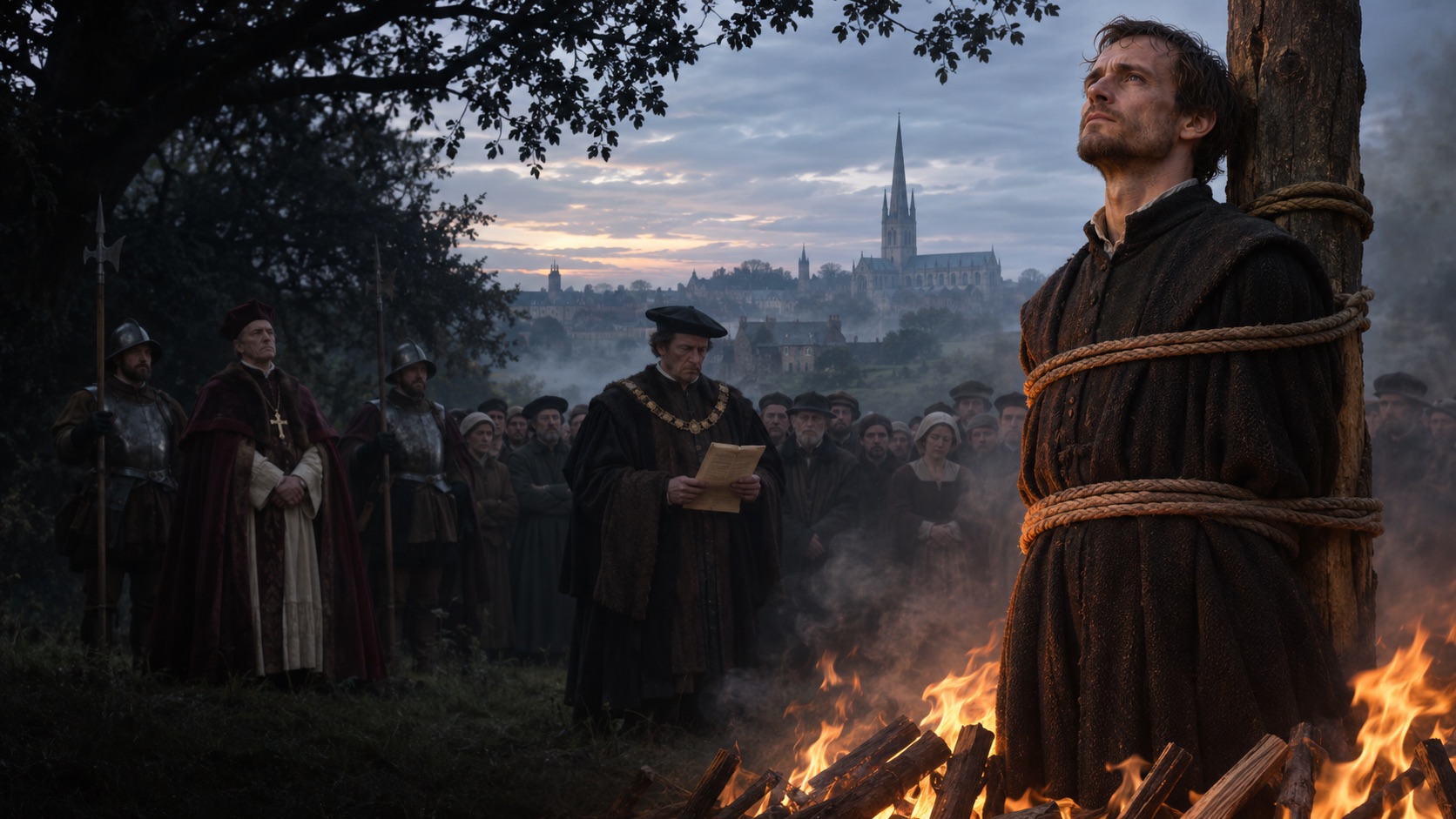
Norwich · 1531
Thomas Bilney
His Bible study helped shape early English reform. Catholic Bishop Richard Nix prosecuted him after he returned to condemned teaching. Bilney was burned at Norwich.
- The work
- Bible scholar and preacher
- Place of execution
- Norwich
- Year
- 1531
A reader’s Bible survives
His own notes let us look beyond the legend.
Bilney was a Cambridge scholar and an influential early evangelical preacher. His encounters helped shape Hugh Latimer and Robert Barnes.
His annotated Latin Bible survives in the Parker Library at Corpus Christi College, Cambridge. Recent research examines the notes directly, including his questions about Scripture, salvation and church teaching. His thinking was more complex than a modern denominational label can convey.
Cambridge University Press: On the Vulgate of Thomas Bilney ↗
The charge · Relapsed heresy
He returned to preaching after an earlier recantation.
In 1527, Bilney renounced teachings the authorities had condemned. In 1531 he resumed preaching in Norfolk and faced another prosecution.
Richard Nix, the Catholic bishop of Norwich, had him arrested and tried. Returning to condemned beliefs made him a relapsed heretic in the court’s judgment.
Greg Walker: Bilney’s heresy trial reconsidered ↗ · Oxford Academic: Bishop Richard Nix and Thomas Bilney ↗
Norwich · August 1531
The prosecution ended in a public burning.
Bilney was stripped of his clerical standing, handed to the civil authorities and burned at Norwich in August 1531. The bishop’s prosecution was central to the execution.
Accounts differ about whether he recanted again before his death. Thomas More and John Foxe presented opposing interpretations, and historians continue to examine the evidence. This page does not invent final words or treat that disputed question as settled.
Greg Walker: Bilney’s heresy trial reconsidered ↗ · Oxford Academic: Bishop Richard Nix and Thomas Bilney ↗ · Dictionary of National Biography: Thomas Bilney ↗
Remember the person
A difficult record still deserves an honest hearing.
Bilney left questions in the margins of a Bible. Reading them allows us to encounter a person working through belief, rather than a flawless figure constructed after his death.
Whatever judgment a reader reaches about his final moments, his execution remains a warning about making a contested confession of faith a matter of life and death.
Cambridge University Press: On the Vulgate of Thomas Bilney ↗
Read the record
Sources behind the story.
- Cambridge University Press: On the Vulgate of Thomas Bilney ↗
- Colin Michael Donnelly’s 2022 study examines Bilney’s surviving handwritten annotations and corrects earlier misreadings.
- Greg Walker: Bilney’s heresy trial reconsidered ↗
- Scholarly account explaining the conflicting interpretations offered by More and Foxe.
- Oxford Academic: Bishop Richard Nix and Thomas Bilney ↗
- David R. Carlson’s study identifies Nix’s role in Bilney’s renewed arrest, trial and burning in 1531.
- Dictionary of National Biography: Thomas Bilney ↗
- Older biography describing the transfer to civil authorities and competing reports of his final actions; read alongside the modern studies.
The illustration is a historical composite. It does not establish a particular official’s presence or physical actions. Historical claims are linked above; moral and theological judgments are this site’s Protestant commentary.