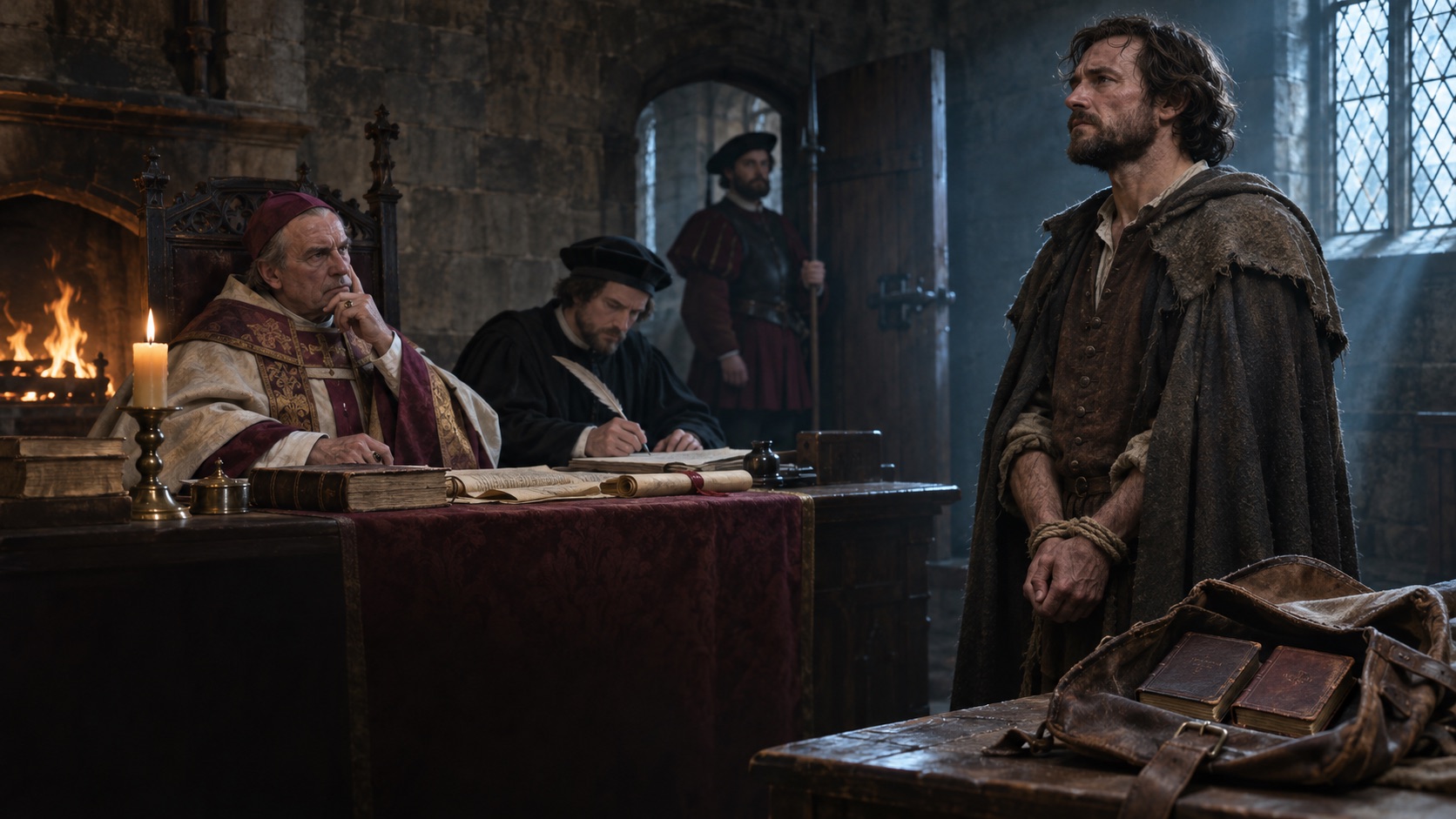
Maidstone, Kent · 1530
Thomas Hitton
He carried English New Testaments into England. Catholic bishops William Warham and John Fisher examined him. He was condemned for heresy and burned at Maidstone.
- The work
- Carrier of English New Testaments
- Place of execution
- Maidstone, Kent
- Year
- 1530
Books crossing the Channel
He helped the pages reach England.
Hitton brought prohibited religious books from the Continent into Kent. The record of his examination includes English New Testaments and an English primer.
His contribution was carrying books to readers. That practical work placed him in the dangerous network surrounding Tyndale’s English Scriptures.
University of Kent: the early Reformation in Canterbury ↗ · William Tyndale: An Answer to Sir Thomas More’s Dialogue ↗
The charge · Heresy
The books became evidence against him.
William Warham, the Catholic archbishop of Canterbury, repeatedly questioned Hitton. John Fisher, bishop of Rochester, was also involved in the examinations.
The case concerned his religious convictions as well as the books he imported. He would not give the authorities the renunciation they demanded. The church proceedings ended in condemnation and his delivery to civil power.
University of Kent: the early Reformation in Canterbury ↗ · William Tyndale: An Answer to Sir Thomas More’s Dialogue ↗
Maidstone · 1530
Tyndale named the bishops responsible.
Hitton was burned at Maidstone in 1530. In his Answer to More, Tyndale expressly blamed the bishops of Canterbury and Rochester for his death.
Tyndale wrote as a committed opponent of the prosecution. The scholarly edition links his accusation to the accounts of Hitton’s examinations. Catholic condemnation and execution by secular authorities were connected parts of the case.
University of Kent: the early Reformation in Canterbury ↗ · William Tyndale: An Answer to Sir Thomas More’s Dialogue ↗
The carrier beside the translator
A translation still needs a way into someone’s hands.
Hitton’s story makes the journey of a Bible personal. A printer could produce a book abroad; someone still had to bring it across the water.
Why did carrying these pages, together with the beliefs they expressed, bring a man before authorities who could send him to the stake?
Read the record
Sources behind the story.
- University of Kent: the early Reformation in Canterbury ↗
- James H. S. Palmer’s doctoral thesis, especially printed pages 158 and 246, identifies the books and Warham’s proceedings. His clerical or lay status is disputed, so this page does not assign him an occupation.
- William Tyndale: An Answer to Sir Thomas More’s Dialogue ↗
- University-hosted edition with scholarly commentary. Search within the text for Hitton; Tyndale names Canterbury and Rochester, and the notes identify Warham, Fisher and the examination accounts.
The illustration is a historical composite. It does not establish a particular official’s presence or physical actions. Historical claims are linked above; moral and theological judgments are this site’s Protestant commentary.